
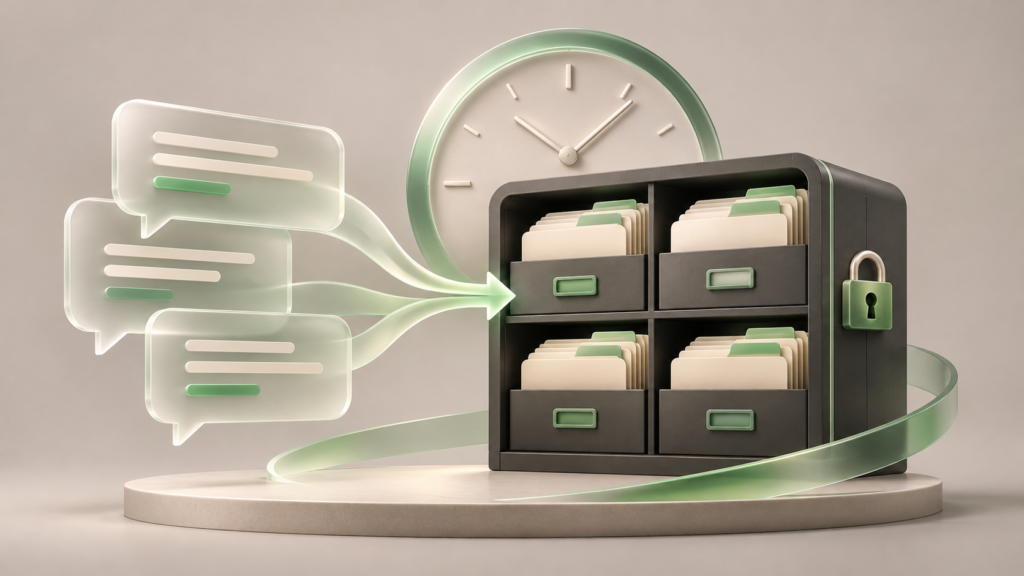
Law departments are asking a new question: how long should we keep AI prompts and outputs? No uniform standard answers it yet. Courts, regulators, and standards bodies are moving fast, and legal hold practices will follow. This post summarises what Elevate’s eDiscovery and AI Consulting teams see across customer conversations, platform updates, and case law.
AI is not new, but the market has not yet settled on a mature or uniform standard for AI prompt and output retention. The direction of travel, however, is becoming clearer: organisations are generally looking to integrate AI-generated information into existing information governance and records management frameworks rather than creating entirely separate retention regimes for AI. Developing a generative AI data retention policy can help organisations apply consistent principles across their AI-enabled workflows.
The core principle is straightforward: retention should follow the business function and risk profile of the AI interaction, not simply the fact that AI was used. A draft generated by AI and never used in a business decision may warrant a different posture than an AI-generated analysis used to support an employment decision, compliance assessment, investigation, regulatory communication, or litigation strategy.
Major enterprise platforms (i.e., Copilot, ChatGPT, Claude, etc.) are also moving in this direction by adding compliance, retention, audit, and export capabilities for AI interactions. That product movement is an important market signal: AI prompts and responses are increasingly being treated as governance-relevant information that may need to be searched, retained, held, exported, or defensibly disposed depending on context.
Microsoft and Google have already turned this into a compliance feature. Purview’s retention for AI apps captures user prompts and responses from Microsoft 365 Copilot and Copilot Studio, along with other AI apps it can see. On the Google side, Vault can search Gemini app conversations and, per Google, retain, hold, search, and export that Gemini data, including prompts and responses. These capabilities also support AI data retention requirements.
- Legal and eDiscovery relevance: whether prompts, outputs, drafts, summaries, or logs are relevant and proportional to the claims, defences, investigation, or regulatory inquiry at issue.
- Regulatory recordkeeping: whether the AI interaction becomes part of a regulated communication, financial record, employment record, audit record, government record, or other required business record.
- Privacy and data minimisation: whether prompts contain personal information, privileged material, confidential business information, trade secrets, source code, health information, or other sensitive data.
- Security and auditability: whether the organisation can determine who used which tool, what data was provided, what output was generated, and whether that output influenced a business action.
- Technical feasibility: whether the relevant platform exposes export, legal hold, audit log, version history, source lineage, or collection functionality in a reliable and repeatable way.
- Vendor and deployment model: whether the tool is consumer-grade, business, enterprise, API-based, zero-data-retention, embedded in a productivity suite, or part of a specialised legal technology platform. These factors influence retention policies for AI prompts and responses.
AI interactions are increasingly being viewed as potential electronically stored information. The more balanced framing is not that all AI data must be preserved, but that AI data may be preservable and discoverable when it is relevant, proportional, and tied to the issues in dispute or the matter under investigation.
Our corporate customers are beginning to have these conversations. We expect legal hold notices, custodian questionnaires, and discovery scoping discussions to increasingly include AI-specific questions, such as whether custodians used AI tools in connection with the facts, documents, communications, analysis, summaries, decisions, or workflows at issue.
Where AI use is potentially relevant, organisations assessing collection options may need to understand the tool used, account type, custodian identity, prompt and output content, timestamps, conversation identifiers, files uploaded, source documents referenced, model or version information where available, audit logs, deletion settings, export functionality, and whether the output was copied into another system of record. These details may be essential for AI prompt log retention.
From a processing standpoint, AI prompt and response data is beginning to look more like modern chat or collaboration data than traditional documents. Depending on the platform and export format, organisations may need to preserve conversational context, metadata, attachments, thread structure, and downstream copies in systems such as email, collaboration tools, document repositories, ticketing systems, case-management platforms, or review databases.
We have yet to see an electronically stored information (ESI) protocol that explicitly includes AI prompts, but we expect to see this data type included in the near future. Although, we do not have full visibility into request for documents across projects, we also expect AI prompt and output data to increasingly appear among requested data types.
AI interactions can be ESI when relevant and proportional; not all AI data needs to be preserved. Recent commentary on AI discovery leans toward targeted preservation of relevant prompts, outputs, AI-generated summaries and drafts, and minimal logs. There is little to no support for wholesale capture of every AI interaction.
Guidance:
- In The New York Times Co. v. Microsoft/OpenAI, the US District Court for the Southern District of New York (SDNY) ordered OpenAI to preserve and segregate output log data that otherwise would have been deleted going forward. That is about the clearest preservation signal we have so far, but it is also very fact-specific and unusually broad, since the case is directly about AI outputs, training, and copyright.
- Tremblay v. OpenAI involved a fight over producing prompts and outputs from the plaintiffs’ ChatGPT testing. Reporting on the June 2024 magistrate order says production was compelled, while later reporting on the August 2024 district court ruling says relief was granted because counsel-crafted prompts could reveal attorney mental impressions and work product. The takeaway: prompts and outputs can be discoverable, but privilege, work product, and proportionality still apply.
The practical balance is selective, policy-driven retention. A well-defined prompt retention policy can help organisations manage these competing considerations.
Organisations should avoid keeping everything indefinitely. AI prompts can be sensitive, duplicative, experimental, or operationally noisy, and over-retention can increase privacy, privilege, trade-secret, breach, and future discovery risk.
Organisations should also avoid keeping nothing. Where AI materially shapes a business, legal, compliance, employment, financial, investigative, or customer-impacting decision, under-retention may create preservation, audit, regulatory, and defensibility concerns.
Resources to monitor (this list is not comprehensive; these are resources we have come across in our research):
- The Sedona Conference Working Group 1 (WG1) has formed a brainstorming group and a drafting team for a Commentary on the Discoverability of Generative AI Information, covering both public prompt-response tools (ChatGPT, Claude) and enterprise tools (Microsoft 365 Copilot), addressing grounding/training data, prompts, inputs, and outputs collectively as ‘GenAI-related data.’ A full draft is targeted for completion by December 2026. Working Group 13 (WG13)’s brainstorming group is using the 2019 IG and Defensible Disposition commentaries as the foundation for new GenAI governance guidance, framing the open questions as: how long AI-related content should be retained, when AI-generated data should be considered a ‘record’, who is accountable for AI outputs, and how to dispose of sensitive or obsolete data.
- EDRM. EDRM released the Information Governance Reference Model (IGRM) v4.1 in 2026, its first major revision since 2012, expressly updated for the AI era. It introduces a 'perpetual policy-process cycle’ — governance is never finished; policy shapes process, implementation exposes gaps, and lessons feed the next round of policy. EDRM’s guidance notes AI-generated content 'may trigger retention, privacy, security, and discovery obligations depending on its content, business use, jurisdiction, and governing policies’.’s guidance notes AI-generated content “may trigger retention, privacy, security, and discovery obligations depending on its content, business use, jurisdiction, and governing policies.”
- NIST AI Risk Management Framework (AI RMF 1.0, January 2023; GenAI Profile NIST-AI-600-1, July 2024). The AI RMF is voluntary and organised into four functions (Govern, Map, Measure, Manage). It does not prescribe retention periods, but its Playbook addresses decommissioning policies that should account for '[r]egulatory requirements (e.g., data retention)' and '[p]otential future legal, regulatory, security or forensic investigations.’ NIST’s framework is increasingly treated as a baseline; Texas’s TRAIGA names substantial compliance with the NIST AI RMF as an affirmative defence. AI RMF as an affirmative defence.
- NIST’s Generative AI Profile isn’t a retention schedule, but it is a useful governance reference - it frames GenAI risk management around legal and regulatory requirements, an organisation’s risk tolerance, and its priorities.
- ARMA International. ARMA’s Generally Accepted Recordkeeping Principles (GARP) — including Retention, Disposition, and Compliance — and its Information Governance Implementation Model (IGIM 2.1) provide the records-management backbone now being extended to AI governance, privacy, and AI-readiness.
- FINRA Regulatory Notice 25-07 and the 2026 Annual Regulatory Oversight Report. FINRA’s 2026 report flags GenAI as a key compliance/risk area, reminding firms they must meet the minimum requirements of SEC Rules 17a-3/17a-4, ensure GenAI-assisted customer communications comply with rules, and retain GenAI/chatbot communications to meet recordkeeping requirements. Notice 25-07 expressly asks for input on members’ recordkeeping challenges regarding AI-generated communications and notes that the phrase business as such under Rule 17a-4(b)(4) is not defined.
- NYT v. OpenAI and Tremblay v. OpenAI: early case-law signals on preservation, production, proportionality, and privilege/work product.and Tremblay v. OpenAI: early case-law signals on preservation, production, proportionality, and privilege/work product.
- In United States v. Heppner, a federal court in the Southern District of New York ruled in February 2026 that a defendant’s chats with a consumer AI tool were not protected by privilege or work product. Law departments should treat prompts as potentially discoverable unless privilege is clearly maintained.
- General Counsel (GC) should work with their chief information officers (CIOs) and sourcing and procurement leaders to take the following actions toward their AI-enabled vendors they plan to use in developing legal strategy or guidance:
- Secure prompts and retrieval-augmented generation (RAG) pipelines. Require guardrails against prompt injection, retrieval leakage, and embedding reconstruction. Mandate logging, identity-based access controls, and audit-ready evidence for all retrieval events. Also, preserve legal prompts and extend retention under legal hold processes to them. In the event that privilege is not maintained, these will be subject to discovery. Unauthorised deletion of these prompts once under legal hold may be construed as spoliation of evidence.
Next step: review your legal hold templates, custodian questionnaires, and ESI protocol language for AI-specific questions. Need help building defensible AI data workflows? Contact Elevate’s eDiscovery team.
About the author
Elevate
Contributed by Elevate’s eDiscovery and AI Consulting teams.